

Between the Lines
Fishermen's perspective on state and federal management for Atlantic spiny dogfish

So what does state versus federal fishery management from Fish School #6: Who’s in Charge? look like from a fishermen’s perspective? It can be complicated!
If you fish the Northeast long enough, you learn an uncomfortable truth: the fish are often simpler than the rules. Atlantic spiny dogfish are a perfect example. They’re abundant, widely distributed, and biologically well understood. Yet for fishermen, dogfish can feel confusing to stay compliant with—not because of conservation risk, but because of jurisdiction.


From a fisherman’s point of view, the challenge isn’t whether dogfish can be caught. It’s where you are when you catch them, who’s “in charge” of that patch of water, and whether the rules change as you cross invisible lines.
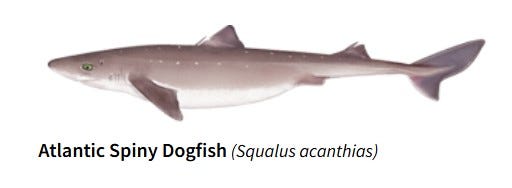
Spiny dogfish are prolific, inhabiting waters around the globe. They might show up on your plate in England as fish and chips or in Germany as shillerlocken, a popular beer garden snack. In the Atlantic ocean, spiny dogfish are found from Canada down to Florida and are predominately caught in commercial fisheries with a much smaller volume of recreational harvests.
Spiny dogfish are managed through a hybrid system: federal rules apply in waters beyond three nautical miles, while states control the first three miles off their coastlines. That sounds tidy on paper. On the water, it’s anything but and there are a lot of states on the East coast. A single tide-pushed set can cross from Massachusetts state waters into federal waters without any obvious visual cue. The fish don’t notice. Enforcement does.
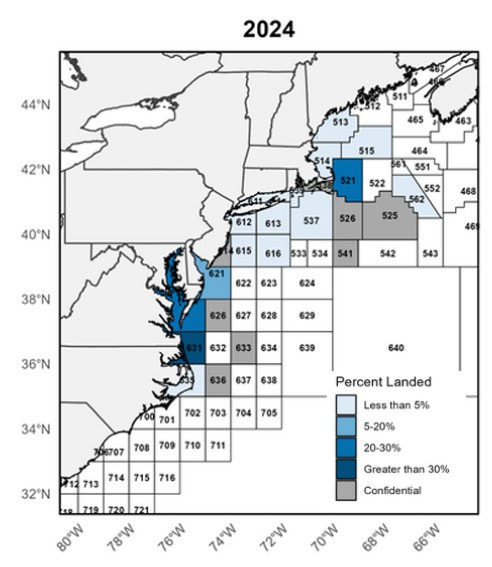
For commercial fishermen, dogfish have trip limits and permits—but states can (and do) add their own layers. Trip limits can vary between states. And some states close their dogfish fisheries early when allocations are reached, even while federal waters remain open. That creates a regulatory split where the same fish is legal to possess outside three miles and illegal inside it. If your gear straddles that boundary, intent doesn’t matter. Location does.
None of this is about dogfish biology. The stock is healthy. Overfishing isn’t occurring. The complexity comes from the layers of governance on a migratory species crossing jurisdictions along an entire seaboard — two federal councils, an interstate commission, and state agencies all managing the same species.
Thankfully, great strides have been made in recent decades to increase coordination between state and federal fisheries and among states. Efforts that have helped the stock stay sustainable. In 2002, the states agreed to an Interstate Fishery Management Plan for Spiny Dogfish that governs state waters along the East Coast from the estuary out to three nautical miles. The federal Fishery Management Plan has been in place since 2000 governing federal waters from three to 200 nautical miles. The Atlantic States Marine Fisheries Commission and the Mid-Atlantic Fishery Management Council are the lead organizations coordinating joint management for spiny dogfish.
Check out NOAA Fisheries webpage for more on Atlantic spiny dogfish commercial fishery requirements.
From the wheelhouse, it can feel less like fisheries management and more like regulatory pinball. A species that’s abundant and accessible becomes a compliance headache simply because lines on a chart matter more than what’s in the gillnet.
Dogfish aren’t hard to catch. Understanding who’s in charge of them and what rules apply based on where you are on the nautical chart, that’s the real challenge.